


High & Dry surveys the legacy of human enterprise in the California desert and beyond. Together, writer Jack Eidt and photographer Osceola Refetoff document human activity, past and present, in the context of future development.
P.S. I Love You
Published in PBS SoCal By Jack Eidt, Photography by Osceola Refetoff
“The spirits are seen in the morning in the desert, in the form of mirages, of people, bodies of water, and villages. Thus, the people know the spirits still live and show their power to the people. We know that we are not forgotten.”
–Francisco Patencio, Cahuilla Elder and Chief, , Stories and Legends of the Palm Springs Indians, with Margaret Boynton, 1943
The blooming desert miracle that would become Palm Springs all began with the Agua Caliente Hot Mineral Springs. The sacred water source of the original Cahuilla People was considered more than just a commodity, but a living being, a sentient entity with its own rights. The Agua Caliente valley location was used for warm baths, potable water, irrigation, and healing powers. The hot springs and the surrounding grove of indigenous Desert Fan Palm trees spawned the name Palm Springs, a place that would attract spa retreatants, SoCal weekenders, retirees, and snowbirds from all over the world.
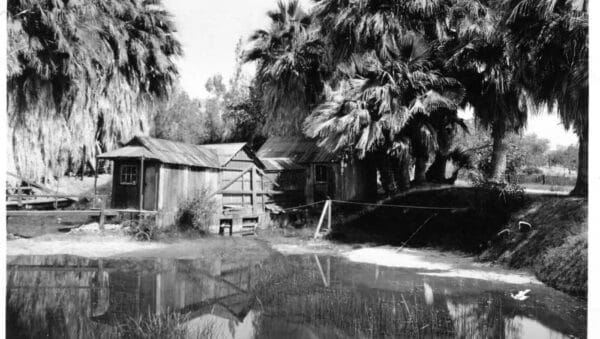
Yet it took me decades to learn about the history of the Agua Caliente, as my relationship with P.S. started when my college-girfriend’s-family leased a condo some blocks away from the Spring. To us the word meant Spring Break, car-cruising the streets downtown, late-night tequila parties, and hung-over basking around the pool in the burning hot sun. Like most visitors, I had no idea about the sacred spring and the people that stewarded it, right there, around the corner. And maybe the real estate developers who built the city did not consider the valuable water flowing from underground a sacred living being. Thus, we have a disconnect between the Springs and the people who use it today.
The abundance from the underground hot spring aquifer, fed and replenished by the adjacent Colorado River aqueduct, has sprouted a glamorous vacationland and wellness retreat. P.S. is on the map for its mid-century modern architecture, arts scene, LGBT culture, and international music and film events. And don’t forget the extravagant fountained golf resorts and water parks.

It’s hot-glorious Sinatra-styled swimming-pool-fabulous setting, where Presidents and soap-opera-stars come to sunlounge, is considered the Colorado Desert (named for the river, not the state). Despite more summer monsoon humidity and storms, its changing climate gets hotter and drier every year. And the fossil-fueled sprawl continues to bulldoze the mesquite and creosote bush scrub in favor of non-native tropically palmed boulevards and mountain view condos with no end in sight.
How long can all this sub-urbane plenitude last is what I always ask myself when surveying the burgeoning synthetic-oasis spreading across the Coachella Valley and into the Imperial Valley?

To understand how we might better-adapt to this harsh desert, we turn to Cahuilla Chief Francisco Patencio’s origin story for the hot spring at the palms. He told of a headman, growing old and infirm, who stuck his power-staff into the ground, causing water from this spring to flow. He named it Séc-he, meaning the sound of boiling water, which was the original name of the settlement that would become Palm Springs. In Spanish it translated to Agua Caliente when the reservation was established in 1876. Séc-he bubbled from an earth-portal seen as the underworld where the nukatem, ancient sacred beings, lived. The Agua Caliente Spring at the Palms would flow forever and always be a source of health and wellness for the people.
STORY: Ghost Towns and Geoglyphs: Exploring Chile’s Atacama Desert

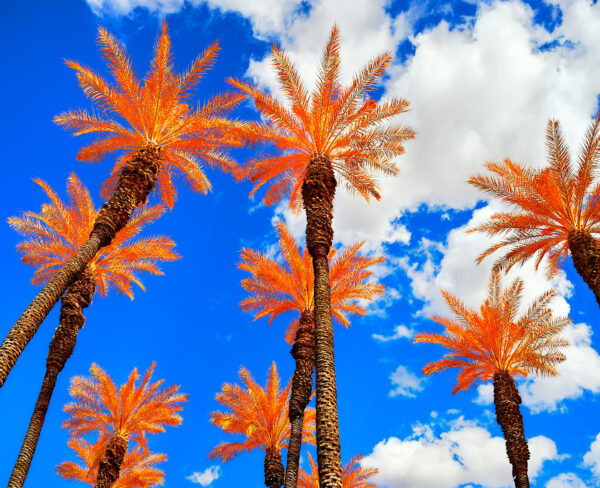
The native Desert Fan Palm, known as Washingtonia filfera, sprouted from permanent springs with flowering fruits that can grow to 66 feet tall. They are fire-adapted, requiring burns to keep the bugs away and allow the fruits to grow and species to prosper. The story from Francisco Patencio is that Ma-ul was growing old and wanted to leave something good behind. So, he stood firm at a spring and his feet turned into roots, bark formed around his legs, and his hair grew into palm fronds. He transformed into the first palm tree. In the rush to imitate and I dare say mock this phenomenon, resort and condo developers have proliferated what art critic Shana Nys Dambrot called Problematic Palms, the title of a 2023 show featuring Osceola Refetoff’s work at College of the Desert:
“…Iconic silhouettes of sunshine and noir; interfered with by industry, transplant beloved of environmentally devastating real estate schemes; decor for seats of all kinds of power from civic institutions to Hollywood studios, guardian angel of the Palm Springs proto-Pop modernist fantasy and its untenable appetite for groundwater; avatars for the role of humans in making the world the way it is now.”

Our way toward a better-desert-adaptation is embodied in the ancient Cahuilla concept of ?kiva?a (pronounced with a double glottal stop), the generative force or power from which all things were created. I learned this from anthropologist Lowell J. Bean’s book, Mukat’s People, regarding the beliefs of the forebears to the Agua Caliente Indians of today. Okay, stay with me, as this gets a little esoteric. From this ?kiva?a—what we might call the living forces of the universe: like sun, wind, fire, and of course water—are seen as interacting, cooperating, as part of a system. This system can work against us when we get out of line, like us burning too much fossil fuels has caused the climate to go haywire. This is what we call today, an ecological ethic.
Humans are an integral part of this reciprocal natural system, meaning we have an obligation to give back to the natural forces when we take. So how do we give back to the desert? Let’s think about how we use our ?kiva?a generative power in building these mega-retirement-suburbs in an inherently unstable and unforgiving desert based on water which may not always be as plentiful as it is today.
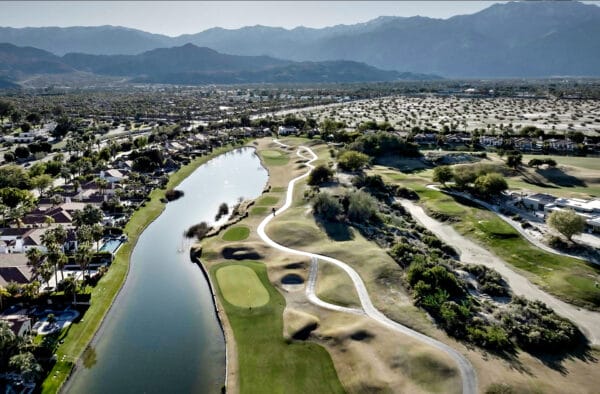
The Coachella Valley lives off the wonder of this ready-to-drink 39-million-acre-feet capacity aquifer, replenished in drought years from the Colorado River Aqueduct and as a last resort the California Water Project from NorCal. Groundwater depletion is a serious threat to survival in one of our hottest and driest regions like the Colorado Desert. Some of the roughly 120 Coachella Valley golf courses consume up to one million gallons a day. Some courses use recycled non-potable water. Conservation measures like replacing turf with native vegetation and reducing the dangerous chemical burden can make a difference. To build in resilience toward an uncertain future, we need all Coachella Valley golf courses to use their generative power to reduce their water usage.
The Thermal Beach Club, with a 22-acre surfing lagoon is envisioned for just north of the drying Salton Sea. We discussed the issue of Salton Sea water scarcity in an earlier dispatch. This project would violate every tenant of its path to restoration. Gnarly-wave-machines in the desert, you heard that right, which would prompt annual evaporation of 5 million gallons of potable water amid all those sunscreen-slathered boogie-boarders.
To get us further in trouble, Crystal Lagoon, planned as a Disney project for Rancho Mirage, includes a 34-acre swimming lagoon filled out with 62 million gallons of water, pumped directly out of the aquifer. They do promise to pay for groundwater replenishment with Colorado River water, a living being already consumed by sun-drenched tract-homes, agricultural bonanzas, and putting greens in six states and Baja California.
Water experts have advised an urgent need to cut water use on the Colorado, particularly groundwater pumping, to avert a deepening crisis. Maybe we could use a re-think of how we use our power here too, less wave machines, less water-thirsty alfalfa and cattle, and more emphasis on how to rehydrate desiccated landscapes through restoration of willow wetlands and creosote bush in historic watercourses and slopes. With an ethic based on reciprocity, we can learn how to give back to our desert, in exchange for the healing and recreation it provides us.

I finally found my way on foot to the wild flowing spring heralded by desert fan palms in Tahquitz Canyon (pronounced Tah-kwitz). Tahquitz is one of the primary nukatam or ancient sacred beings who the traditional stories say went awry from the basic premise of ?kiva?a. He lives in a cave high on Mount San Jacinto that looms over Palm Springs.
“Tahquitz was a man of great power. He was one of the first creators. But he did not do any good… He became a very bad spirit. He speaks through thunder and lightning, and is seen everywhere. He kills the people, and also spirits of the people. He kills animals as well. Causes the wrecks of trains and automobiles, and delights in everything that makes people trouble.” — Francisco Patencio
The only way us humans can visit the dangerous realm of this malevolent being who causes environmental disaster, is to protect ourselves when we venture into his realm with a bottle of water, good boots, and maybe a coat during winter. The spring is magical, with a waterfall, rock art, and an ancient irrigation system that still flows water down to the valley floor.
STORY: Climate Change in the Desert with Ecologist James Cornett
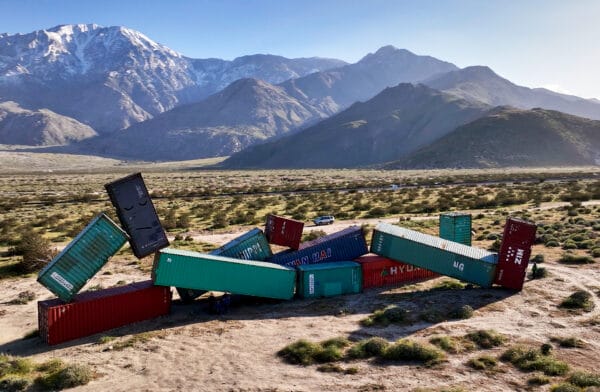
The ancient Cahuilla understood to respect the power of Tahquitz who wanted nothing more than to kill them all. If we want to avert the disaster-drought-earthquake-fire-trap, we better show some respect, take precautions, and plan actions to mitigate the scientific reality about our heating climate and dwindling water supplies. Let’s collect our rainwater in a barrel next to the house, switch to water-efficient practices and appliances in home and gardens. Over time, those grapefruit trees, spitting fountains, and problematic palms could be replaced with pollinator plants and native cottonwoods.
It’s not too late to recognize our folly and make amends to Tahquitz and other nukatem spirit beings like the overseer of the springs, hooved animals, firewinds, and controllers of the weather. Yes, we are all dancing with dangerous forces, and the art shows, tequila parties, and rounds of golf can be good medicine too. Nevertheless, the time is now for every one of us to participate in generating positive power, ?kiva?a, for the betterment of our palms, our springs, our world.

Explore more High & Dry on PBS SoCal: www.pbssocal.org/high-dry. We welcome your questions and comments: info@desertdispatches.com
Further Reading on the Cahuilla People and their History
Cahuilla Band of Indians Culture: https://cahuilla-nsn.gov/about/culture/
Story of the Cahuilla People from the Agua Caliente Band: https://www.aguacaliente.org/history
Stories and Legends of the Palm Springs Indians by Chief Francisco Patencio, as told to Margaret Boynton, Times-Mirror Press, 1943: https://www.google.com/books/edition/Stories_and_Legends_of_the_Palm_Springs/HBTXAAAAMAAJ?hl=en
Mukat’s People, The Cahuilla Indians of Southern California by Lowell John Bean, University of California Press, 1974: https://www.ucpress.edu/books/mukats-people/paper
Originally published 13 January 2026





HI Jack
We met at SB Writers Conference. Think we were going to trade stories about Native Americans. Saw your Wildly Popular on the right. My family has had a lot of experiences, and I’ve known some very interesting people. I’m in San Pedro, CA.